Introduction
Quick commerce has changed the way India shops for groceries and everyday essentials.
With platforms like Blinkit, Zepto and Instamart promising deliveries in minutes, consumers have become comfortable ordering everything from milk and fruits to packaged food and frozen products with just a few taps.
But there is another side to this convenience that is now getting serious regulatory attention: food safety.
In Maharashtra, the Food and Drug Administration (FDA) has suspended 14 food business licences linked to quick-commerce establishments after a statewide inspection drive found multiple food safety and hygiene violations. The action followed inspections of 86 establishments involved in storing, selling and delivering food through online platforms. The FDA also issued 60 improvement notices and directed one establishment to immediately stop operations.
The message is clear: speed cannot come at the cost of food safety.
Summary
The Maharashtra FDA’s latest crackdown highlights a growing challenge for India’s quick-commerce industry.
Among the 14 suspended licences, five were associated with Blinkit, five with Zepto and two with Instamart, while the remaining two involved other establishments.
Inspectors reportedly found issues including poor cleanliness, pest-control failures, improper food storage, inadequate temperature control, poor worker hygiene and expired food products. In some locations, authorities reported cockroaches, rodent-related contamination concerns and other serious hygiene lapses.
This is not just a regulatory story. It is a business lesson.
As quick commerce becomes a larger part of India’s food and grocery ecosystem, companies will have to treat food safety, operational transparency and customer trust as core parts of their brand—not back-end compliance tasks.
1. The Quick-Commerce Model Is Built on Speed
The biggest advantage of quick commerce is also one of its biggest operational challenges.
The entire model is designed around speed.
A customer places an order, a dark store receives it, a worker picks and packs the products, and a delivery partner gets the order to the customer within minutes.
But food products do not become safer simply because they are delivered faster.
Fresh produce, dairy, frozen food and other perishables require proper storage conditions, temperature monitoring, inventory rotation, pest control and regular cleaning.
When businesses optimise every second of the delivery process, they also need to ensure that food safety does not become the process that gets ignored.
The Maharashtra FDA’s inspection drive shows why this matters.
2. Dark Stores Are Now Part of the Food Supply Chain
One important takeaway from this episode is that dark stores should not be viewed simply as warehouses.
They are increasingly becoming an important part of India’s food retail infrastructure.
A dark store may not look like a traditional supermarket. Customers may never walk inside. But the facility still stores the food that eventually reaches their homes.
That means hygiene standards inside these facilities directly impact consumers.
The Maharashtra FDA is responsible for enforcing food safety laws in the state under the Food Safety and Standards Act, 2006 and related regulations. Its responsibilities include monitoring food businesses and taking action when businesses fail to comply.
For quick-commerce companies, this means dark-store operations need the same seriousness that consumers expect from physical food retailers.
3. Consumer Trust Is the Biggest Risk
A food-safety violation is not just an operational problem.
It is a brand problem.
People may forgive a delivery that arrives five minutes late.
They may not forgive receiving food that appears contaminated, expired or improperly stored.
This is especially important for quick-commerce companies because their entire value proposition is based on trust.
The customer trusts the platform to:
Store products correctly
Maintain expiry-date controls
Handle food hygienically
Maintain cold-chain conditions
Deliver safe products
Respond responsibly when something goes wrong
When that trust breaks, convenience alone may not be enough to retain the customer.
4. Technology Needs to Go Beyond Delivery Tracking
Quick-commerce companies are already technology-driven businesses.
They use algorithms for inventory management, demand forecasting, routing, delivery optimisation and personalised recommendations.
The next step should be applying that same technology to food safety.
For example, companies can use technology for:
Automated expiry monitoring:
Systems can flag products approaching their expiry date and prevent them from being dispatched.
Temperature monitoring:
IoT-enabled sensors can continuously monitor refrigerators and freezers and alert teams when temperatures move outside safe ranges.
Digital hygiene checklists:
Store managers can complete daily hygiene inspections through apps, creating an auditable record.
AI-powered inventory checks:
Computer vision and automated scanning can help identify damaged packaging, incorrect storage or products placed in the wrong locations.
Predictive maintenance:
Technology can identify refrigeration or equipment problems before they affect food quality.
The real opportunity is to make food safety data-driven rather than reactive.
5. Compliance Cannot Be a Once-a-Year Exercise
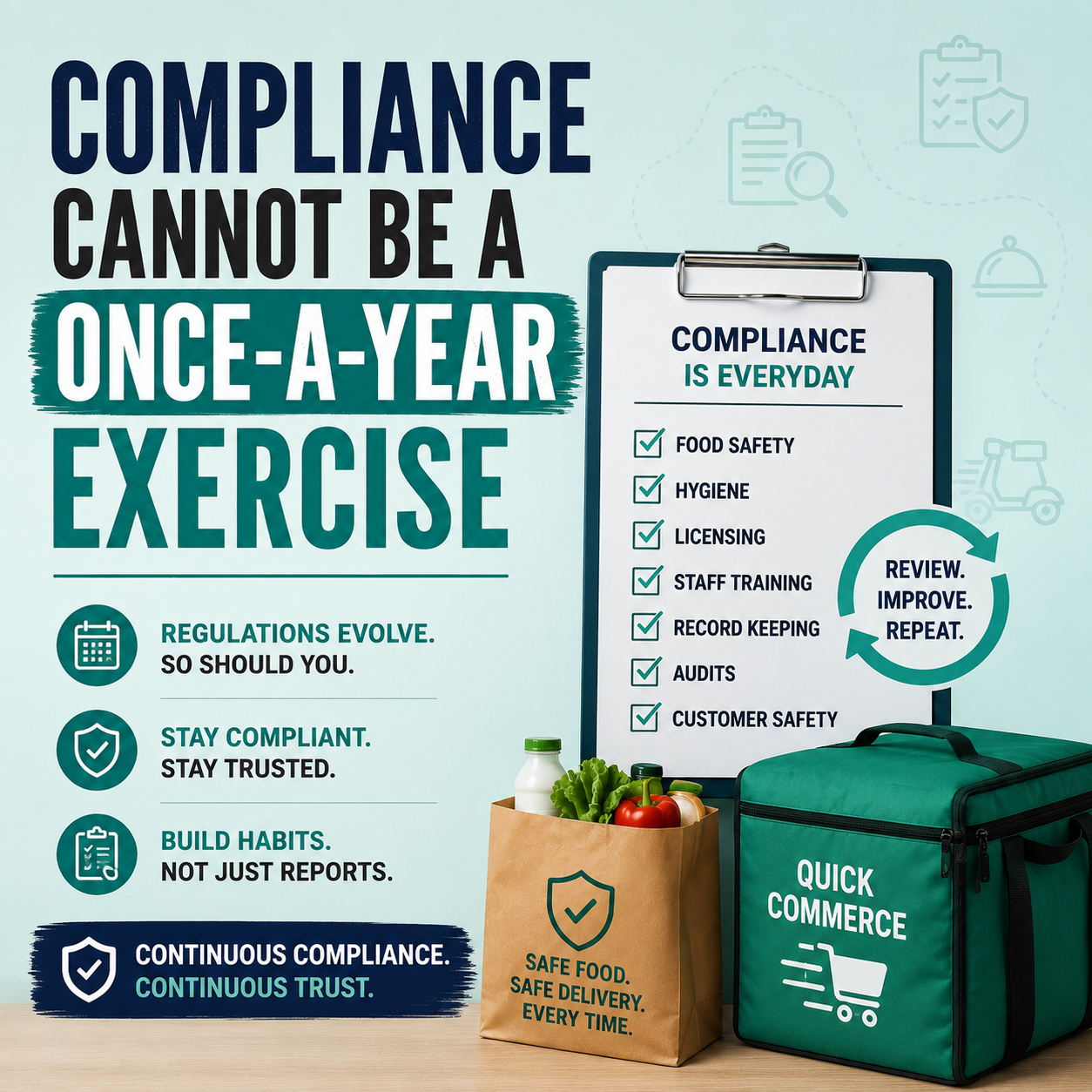
Another important lesson is that compliance should not happen only when regulators arrive.
Maharashtra FDA’s inspection drive reportedly covered 86 establishments and resulted in 60 improvement notices.
That scale of intervention sends a strong signal to the entire industry.
Businesses should conduct their own regular audits before regulators do.
A strong internal system could include:
Daily cleaning audits
Regular pest-control checks
Temperature monitoring
Expiry-date verification
Employee hygiene training
Food-handler health records
Random inventory inspections
Third-party food safety audits
Incident reporting and escalation systems
The goal should be simple: find the problem internally before the customer or regulator finds it externally.
6. This Could Change Quick Commerce in India
The Maharashtra action could have implications beyond the state.
India’s quick-commerce sector is expanding rapidly, and dark stores are becoming a major part of urban retail.
Regulatory scrutiny is likely to increase as these platforms handle larger volumes of food products.
This could push the industry towards stronger standards around:
Food storage → Better infrastructure and temperature controls.
Inventory → More accurate expiry and batch tracking.
Staff → Better training and hygiene protocols.
Audits → More frequent internal and external inspections.
Technology → Greater use of automation and real-time monitoring.
Transparency → Better communication with customers when food-safety incidents occur.
In other words, the next phase of quick commerce may not just be about “How fast can we deliver?”
It may increasingly be about “How safely can we deliver?”
Conclusion
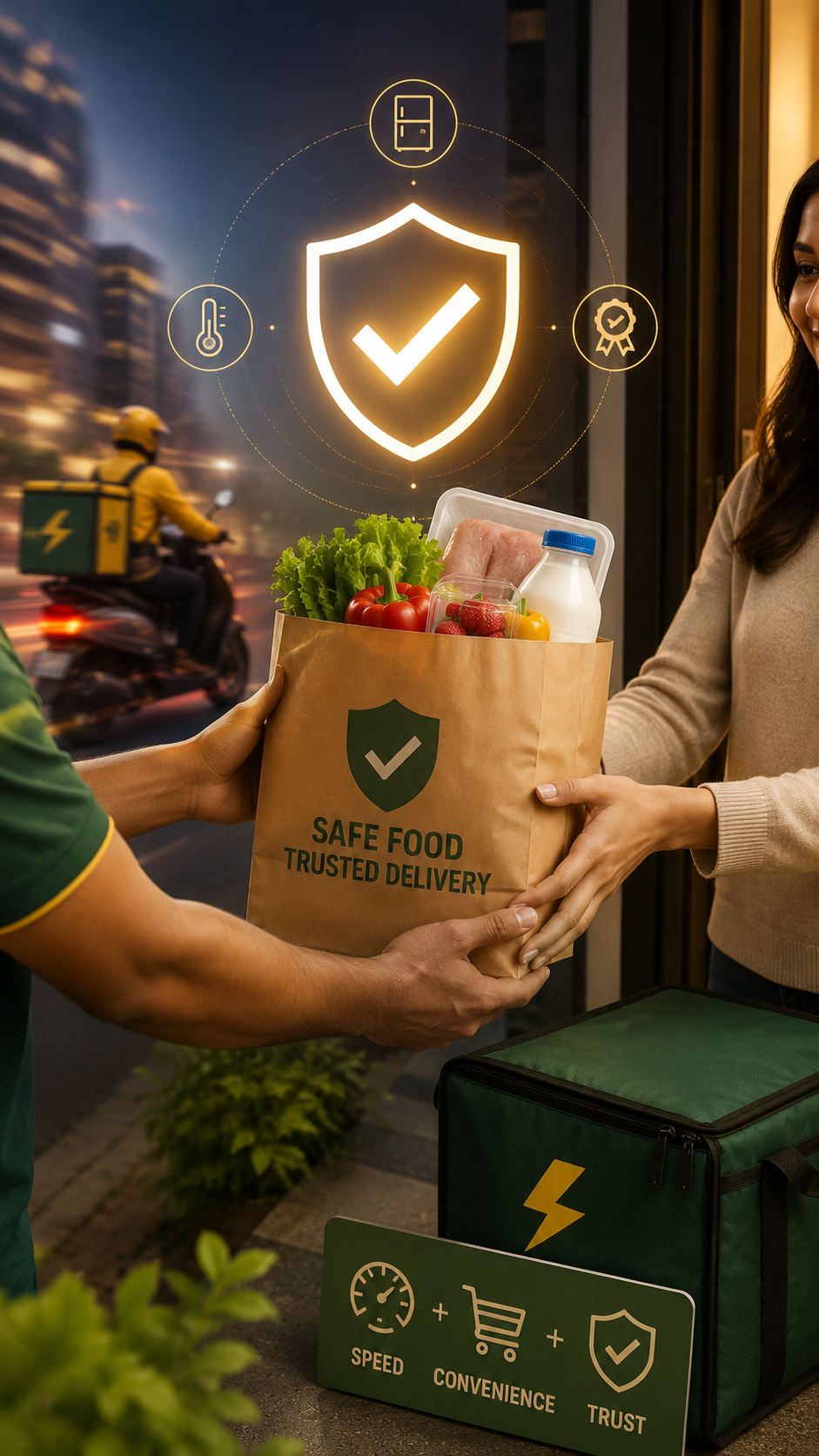
The Maharashtra FDA’s crackdown is a wake-up call for India’s quick-commerce industry.
Blinkit, Zepto and Instamart have helped redefine consumer expectations around convenience and speed. But when these businesses become part of the food supply chain, they also inherit a much bigger responsibility.
A 10-minute delivery means very little if the product has been stored incorrectly.
Technology can optimise delivery times. Algorithms can improve inventory. AI can predict demand.
But ultimately, customer trust depends on the quality and safety of what reaches the customer’s doorstep.
For the quick-commerce industry, the lesson is straightforward:
Speed gets customers. Convenience retains them. But trust builds the brand.
And food safety is one of the foundations of that trust.
The quick-commerce industry is evolving rapidly—and so are customer expectations.
For businesses operating in food, retail, e-commerce or digital commerce, this is the right time to look beyond just sales, speed and visibility and build systems that strengthen customer trust at every touchpoint.
Want to build a stronger digital strategy for your business?
Let’s talk about how technology, data, AI and digital marketing can help your business grow while building long-term customer trust.
Get in touch with us today.